About Barry

Hi there! My name is Arjen but friends call me Barry.

I am a software engineer located in the Netherlands with a passion for problem solving. In 2021, during the pandemic lockdown, I bought my first 3D printer and soon after started learning CAD skills in order to model my own designs.

The combination of my wide skill set, affinity for software and passion for anything tech-related makes for a solid mix to push the boundaries of what is possible and offer products that meet my own high expectations.

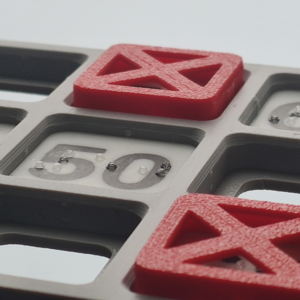
Close-up of a bingo card, showing the braille dots

About Braille Bingo

When a friend with Retinitis Pigmentosa (tunnel vision) reached out looking to host a Bingo game night for a group of people, several blind or with poor eyesight, the first version of the braille bingo card was born. Over the years I have received countless great feedback and continuously made improvements to the design up to where it is today: bingo tiles that are easily readable by braille readers of any skill level, a modular design to build your own card layout and cross-off tiles to place on called numbers and snap into place and stay put.

My bingo cards have since been used, finetuned and approved by hundreds of people and are now used in all kinds of different bingo events, or just a pleasant casual game at home.

How it’s made

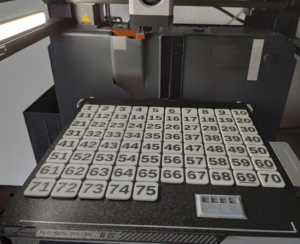
The bingo card, number tiles and red cross-off tiles are 3D printed using modern printers from Bambu Lab. This process, called Fused Deposition Modeling (FDM), enables objects to be produced that would not be possible (or very hard) using traditional manufacturing processes. A prime example of this is how the number tiles are made, where the (black) numbers are embedded inside the (white) tile after which a small transparant layer is added on top and made completely smooth. Lastly the braille “dots” are added, making the number tiles great for both braille and non-braille players.

The materials used are PETG for the card (for its higher heat resistance) and PLA for the other parts. PLA is made from corn starch which is a renewable plant-based source, making it far less taxing on the environment compared to traditional (oil-based) plastics.